
Services · Implementation
CLM implementation and onboarding: contract intelligence in 30 days
Your contracts are searchable, with alerts and reporting on, in the first month. Workflows, templates and customizations follow as each is ready, in your order of priority.
Our implementation philosophy
Time-to-value through a strong foundation, extended one use case at a time.
A contract lifecycle management platform touches every part of an organization. Implementations can quickly become complicated by competing requirements for workflows, templates and reporting, delaying the initial go-live. Contract Logix implementations focus on time-to-value by establishing a strong foundation first and extending the platform one use case at a time.
The first objective is a comprehensive repository that serves as the single source of truth for every contract, with the essential metadata extracted and related contracts connected across each counterparty relationship. That foundation makes every contract searchable and structured, and activates contract data across the business. By the end of the first 30 days, the business has control of and insight into its contracts.
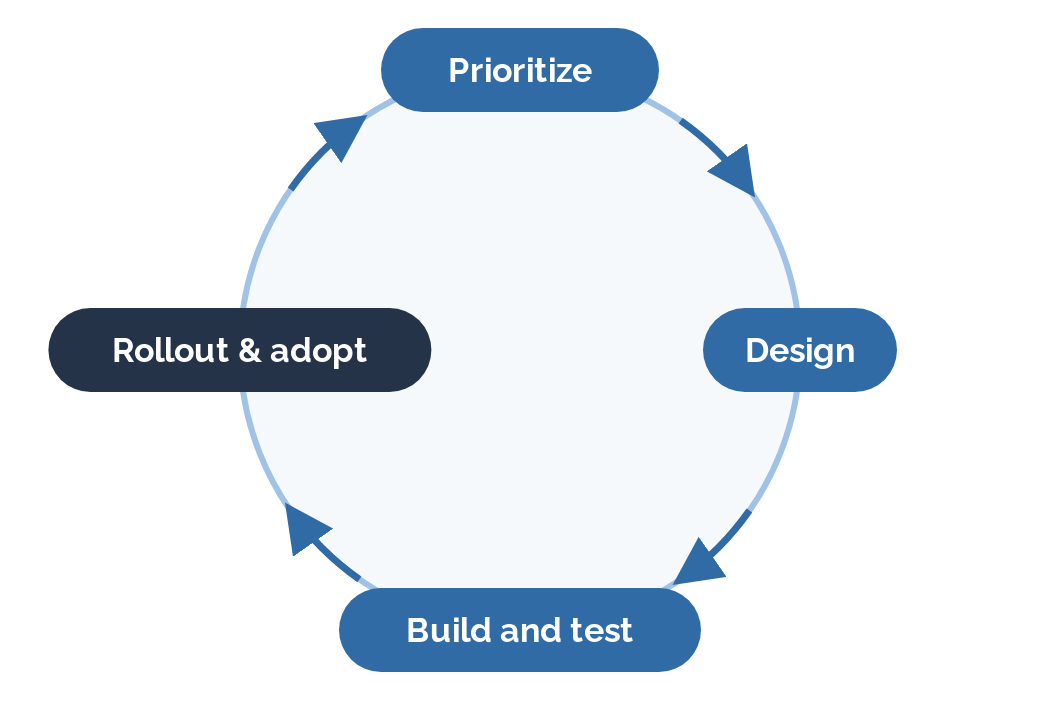
From there, the platform is developed and extended using an agile approach. We identify and prioritize use cases with your team, then take each one through business requirements, design, testing and rollout, creating a continuous improvement loop. Training and adoption follow the same path, so each role and department is trained on the use cases built for it as they go live.
Single source of truth
One comprehensive repository for every executed contract and its supporting documents, with parent-child relationships mapped.
Contract data, activated
The 92 standard fields plus your own custom fields and objects, structured so every function can search, report and act on them.
Agile extension
Workflows, templates, reporting and customizations developed with you in priority order, each in service as soon as it is ready.
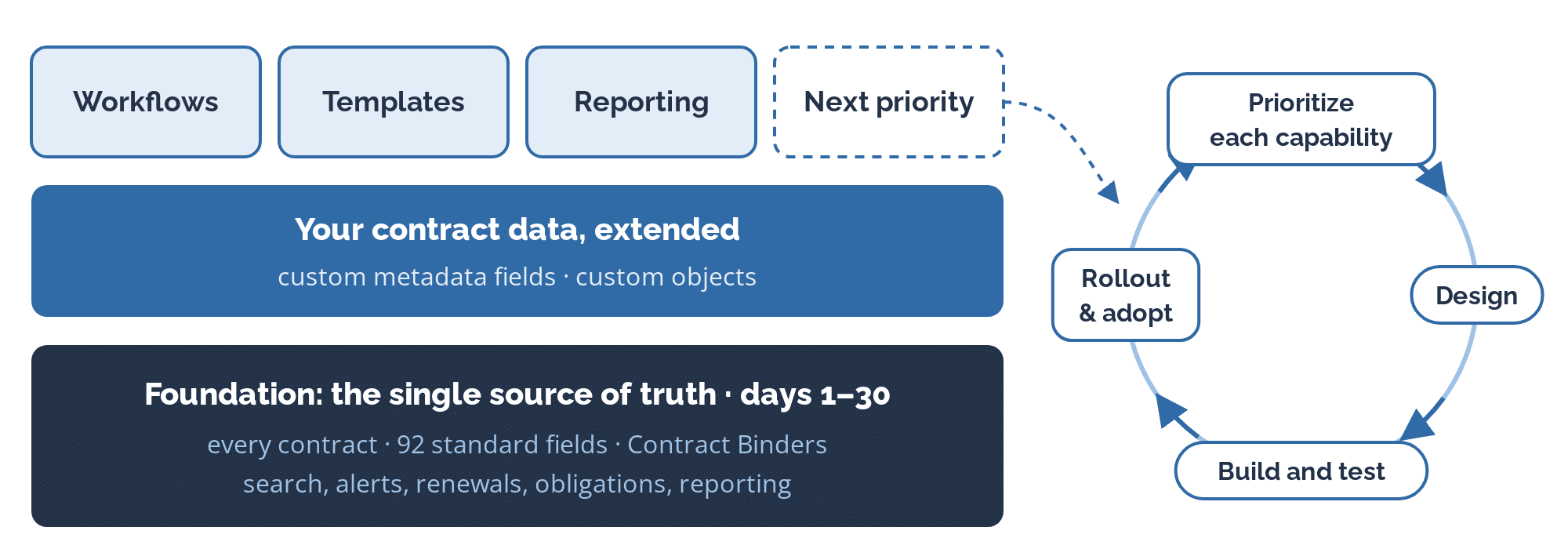
Foundation first, then one use case at a time.
What to expect in the first 30 days, the first 90, and after
What you receive at day 30
- A complete repository, populated with all contracts and the standard metadata fields
- An Intelligence Report summarizing what the system now shows: contract counts by contract type, organization and other dimensions, and alert counts for expirations, renewals and other key dates
- An invitation to your tenant owner
- SSO set up with your IT team (optional)
Why the repository comes first
Workflow design is better when the people designing it can see the portfolio. A populated repository shows which contract types carry the volume, which renewals are coming due and which obligations need owners, so workflow and template priorities are set from your own contract data. It also puts working contract intelligence in front of the business in the first month, while the configuration work that takes longer proceeds one priority at a time.
An agile approach
We deliver this work in an agile way. Together we agree a short list of priorities, then take each one through design, build and testing with the people who will use it. Each goes into use as soon as it is ready instead of being held for a single launch. What we learn from each one, and from your teams using the system, shapes what comes next, and the order changes when your business does.
The pace follows your priorities, the complexity of each item and the availability of your subject-matter experts. Improvement continues after the initial implementation as a normal part of running the system.
What we need from you in the first 30 days
Implementation is delivered by our in-house team, with self-service administration for the changes your own administrators make.
- Your executed contract files and supporting documents, typically PDFs
- The organizational hierarchy your permissions will follow
- The stakeholders and decision-makers for the project
- Your IT team’s time, if you want SSO
Related services and resources
White paper
From Contract Chaos to Contract Intelligence in 30 Days
The full implementation methodology, with the timeline and the comparison with traditional CLM.
Contract Logix Organize™
AI speed and scale with human-validated accuracy, for the contract data your business relies on most.
Data Migration
Bring your existing contract data and documents into Contract Logix quickly and accurately, with built-in import tools and expert help.
Training & Adoption
Flexible live, online, and video training for your administrators and end users.
Contract Operations as a Service
Scalable support for your contract workload, at any stage of the lifecycle.
Frequently asked questions
- How long does a Contract Logix implementation take?
- Your contracts are loaded, searchable and reporting within 30 days. Our target is to have the initial implementation substantially complete by day 90, with each workflow, template or customization going into use as soon as it is built and tested. Improvement continues after that in the order your business needs it.
- Is loading our existing contracts included?
- Yes. Our team loads your executed contracts and supporting documents, extracts the 92 standard metadata fields and maps parent-child relationships into Contract Binders as part of implementation. Contract loading and extraction are part of implementation on editions that include AI Data Extraction.
- How is implementation different from data migration?
- Implementation starts from your contract files. Importing records and metadata from another system, such as a prior CLM, a spreadsheet register or a shared-drive index, is data migration and is scoped separately.
- Is the extracted data validated?
- The Contract Intelligence Engine extracts the 92 standard fields during implementation. Human validation of the fields that matter most to your business is delivered through Contract Logix Organize, which can be part of your implementation or added later.
- When are our administrators and users trained?
- Administrators are trained at the end of the first 30 days, so your own team can make many changes itself. Users are trained on the use cases built for their roles as each one goes live.
- What happens after day 90?
- Day 90 is our target for completing the scope agreed at signing. After that, each new priority, such as a new contract type, a new approval path or new data your teams want reported, runs the same cycle of requirements, build, test and rollout, with user training as it goes live.
Ready to implement Contract Logix?
Talk to our implementation team about your contracts, your priorities and your first 30 days.