
5 Contract Management OKRs to Improve Performance and Results
Traditional KPIs have long been the standard for tracking performance in contract management. Yet many organizations now recognize their limitations. KPIs often measure outputs rather than outcomes, providing historical data but not direction. In contrast, objectives and key results (OKRs) offer a forward-looking framework that aligns contract goals with measurable business impact.
By defining what success looks like and setting clear targets, contract management OKRs help legal, procurement, and finance teams move from tracking activity to achieving real improvement. Supported by modern contract management software, OKRs transform data into actionable insights that accelerate performance, strengthen compliance, and minimize risk.
Quick Takeaways
- Contract management OKRs connect contract operations to measurable business goals.
- OKRs improve visibility, accountability, and continuous performance management.
- Data-driven contract management software enables real-time tracking of contract OKRs.
- Aligning contract OKRs across departments enhances collaboration and decision-making.
😉Learn how leading organizations measure and optimize performance with data-driven insights.
Download our whitepaper, 10 Contract Lifecycle Management KPIs Every Business Needs.
1. Objective: Improve Contract Visibility and Data Accuracy
A common challenge in contract management is incomplete or fragmented data. When agreements live in shared drives and email threads, teams struggle to answer basic questions such as how many active contracts exist or when key renewals occur.
Setting an OKR around visibility encourages teams to define a measurable target, such as achieving 100% contract digitization or reducing missing metadata fields by 90%.
Key Results might include:
- Centralize all active contracts within the contract management platform.
- Achieve 95% accuracy in extracted contract data through AI-powered data extraction.
- Implement standardized naming and tagging for every new agreement.
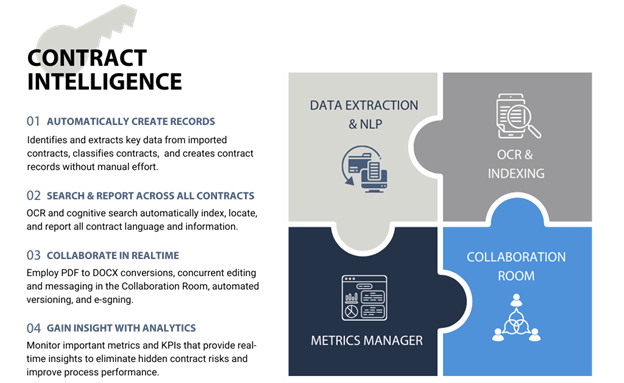
AI-enabled features such as multi- and single-document data extraction and cognitive search make these results attainable. Structured contract data then becomes the foundation for accurate reporting and better decisions.
2. Objective: Reduce Contract Risk Exposure
Every contract introduces some level of risk, but unmanaged risk leads to costly consequences. Rather than measuring risk through incident reports alone, contract management OKRs help teams proactively reduce exposure.
Key Results might include:
- Identify and categorize high-risk clauses and terms using automated search and metadata tagging tools.
- Reduce missed renewal obligations by 90% through automated alerts.
- Achieve full compliance tracking across all contract types.
When combined with centralized risk scoring and alert automation, these OKRs create transparency around potential issues before they escalate. A data-driven approach supports real-time visibility into obligations, helping organizations protect revenue and maintain compliance.
3. Objective: Shorten Contract Cycle Times
Long approval and negotiation cycles delay revenue recognition and hinder operational efficiency. Setting an OKR for cycle time reduction gives teams a clear target for improvement.
Key Results might include:
- Reduce average contract lifecycle duration from 45 days to 30 days.
- Decrease approval turnaround time by 40% using automated workflows.
- Increase the percentage of contracts executed with eSignature to 95%.
Cycle time OKRs encourage process optimization through automation and collaboration. Features such as workflow routing, version tracking, and integrated eSignature tools streamline each stage of the lifecycle, allowing contracts to move from request to signature faster and more consistently.
4. Objective: Strengthen Compliance and Governance
Compliance management is a key area where OKRs outperform static KPIs. Instead of measuring compliance incidents after the fact, OKRs define proactive outcomes that prevent them.
Key Results might include:
- Achieve 100% completion of internal compliance checks before execution.
- Monitor all contracts for deviations from approved language in real time.
- Ensure 90% of vendor contracts align with updated organizational and contractual requirements.
These results depend on visibility and automation. Contract management software with built-in audit trails, configurable approval steps, and clause libraries ensures governance remains consistent across departments. OKRs focused on compliance make it easier to demonstrate accountability and readiness for audits.
5. Objective: Maximize Contract Value and Performance
The ultimate purpose of contract management OKRs is to connect contract performance to business outcomes. Tracking contract value realization helps organizations understand not only how efficiently contracts are executed but also how effectively they deliver expected results.
Key Results might include:
- Increase contract renewal rate by 50% through improved obligation tracking.
- Reduce value leakage by 30% by identifying underperforming agreements and addressing missed obligations.
- Achieve complete visibility into 100% of active contracts and at least 90% of legacy agreements.
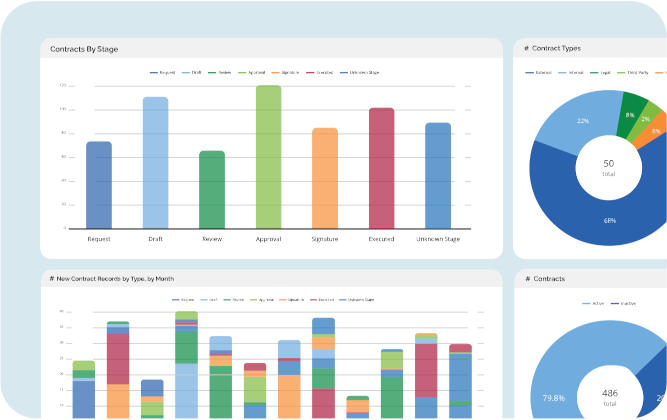
By integrating contract data with analytics dashboards, teams can visualize performance trends and measure how well contracts support revenue and supplier management goals. Over time, these insights drive strategic improvements in vendor selection, pricing, and relationship management.
The Shift from KPIs to OKRs
The move from KPIs to OKRs represents a shift from tracking activity to achieving impact. KPIs measure what has happened; OKRs define what must happen next. For contract management teams, this distinction means aligning operational processes with larger business outcomes.
OKRs also promote cross-functional collaboration. Legal, procurement, finance, and sales can share unified targets (such as shortening cycle times or improving compliance rates) ensuring that every department contributes to shared results.
By adopting contract OKRs, organizations align daily tasks with measurable outcomes that support long-term business objectives.
Contract management software makes this evolution practical by translating data into progress indicators. With automated reporting and configurable dashboards, teams can measure performance in real time, refine strategies, and sustain continuous improvement.
Drive Measurable Success Today with Contract Logix
Contract management OKRs give organizations a structured way to define goals, measure outcomes, and improve performance across the entire lifecycle. They replace static reporting with dynamic insights that promote accountability, agility, and growth.
By combining well-defined objectives with real-time analytics, legal and business teams can connect every contract to measurable business impact. This approach transforms contract management from a compliance function into a strategic performance driver.
Ready to improve performance and visibility across every stage of contract management? Schedule a demo to see how Contract Logix can help your organization operationalize OKRs and achieve measurable results.
Navigate CLM Success With Contract Logix
Download our Data Extraction Product Brief to learn how you can begin to navigate CLM success by automating the hard work using artificial intelligence with one of the best Contract Management Software’s on the market today