
Contract Binders: A Relationship-Centered Architecture for Contract Management
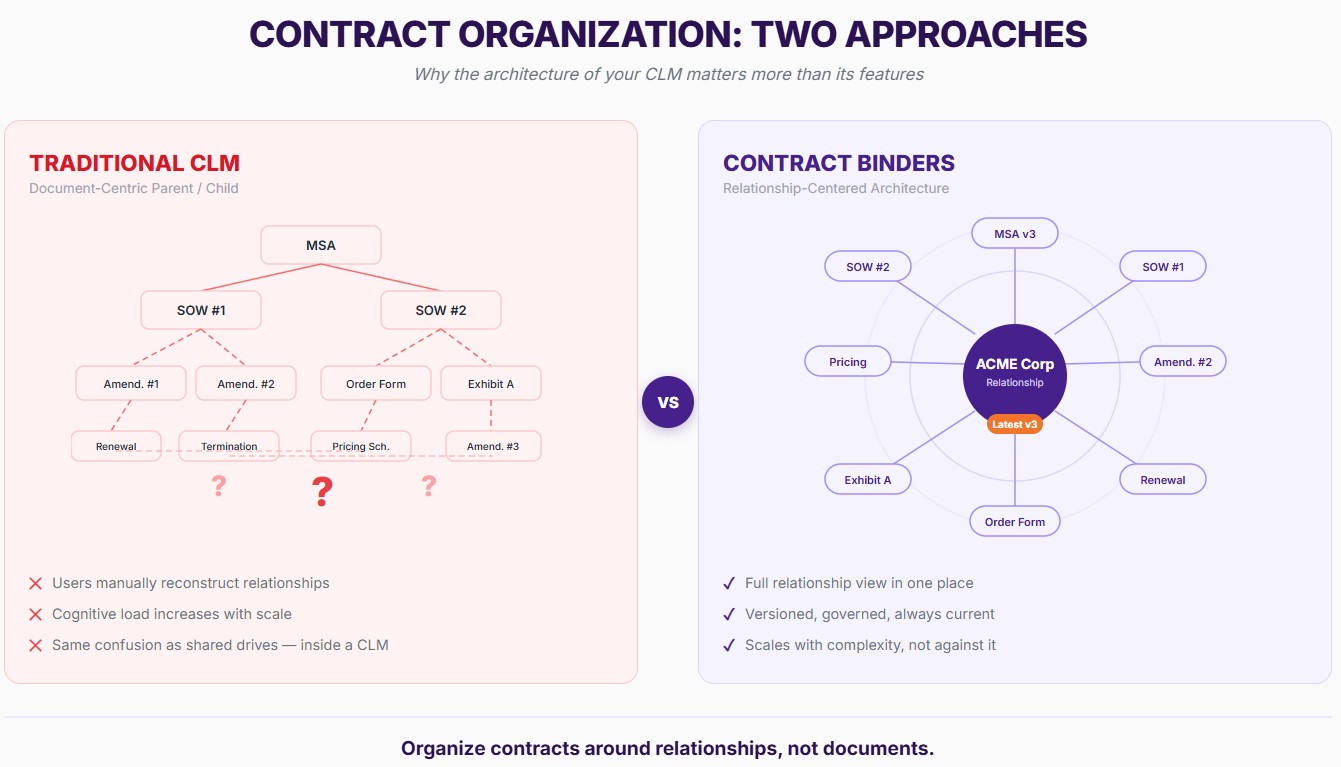
Most contract management systems are built to store documents. But contracts do not function as isolated documents. They function as commercial relationships.
A single customer or vendor relationship may be governed by a master services agreement, multiple statements of work, pricing schedules, amendments, renewals, and termination notices, often executed and modified over many years.
Yet many contract lifecycle management (CLM) platforms still organize this complexity as a collection of linked documents.
Contract binders represent a foundational architectural shift in contract management: organizing contracts around the relationship they govern, not as disconnected documents. That structural decision becomes increasingly important as contract portfolios scale.
Key Takeaways
-
Contracts operate as commercial relationships, not isolated documents. Contract management architecture should reflect that reality.
-
Document-centric CLMs increase complexity at scale, forcing manual reconstruction of context.
-
Contract binders make the relationship the primary organizing principle, consolidating all governing agreements into a single structured record.
-
Coordinated version control eliminates ambiguity with clear “latest,” “active,” and historical views.
-
Architecture determines scalability: the structural design of a CLM system directly impacts governance, visibility, and risk management.
What Are Contract Binders in Contract Management?
Contract binders are a relationship-centered approach to structuring contract management systems. A contract binder groups all agreements governing a specific commercial relationship into a single structured record, becoming the governing view of that relationship across its lifecycle.
It’s important to clarify that a contract binder is not a folder, a tagging system, nor a reporting overlay. It is the architectural foundation of how contracts are organized within a CLM or contract management platform.
Inside a contract binder, organizations can manage:
-
Master agreements
-
Amendments, renewals, and terminations
-
Statements of work (SOWs)
-
Order forms
-
Exhibits and pricing schedules
If it governs the relationship, it belongs in the binder. By structuring contracts this way, contract management systems better reflect how agreements actually function in practice.
The Structural Limitation of Document-Centric Contract Management
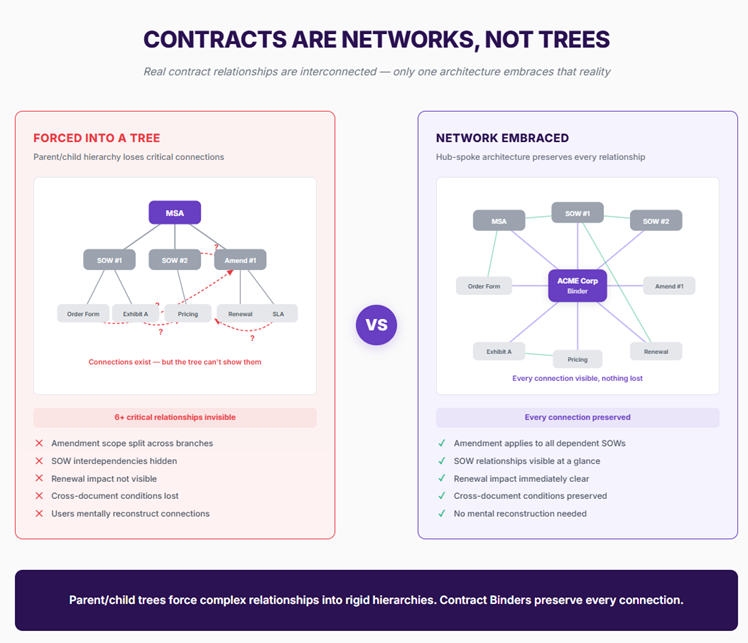
Contracts rarely operate as standalone documents. They evolve through amendments, renewals, and layered agreements.
A contract binder structure reflects this reality by making the relationship, not the individual document, the core organizing principle.
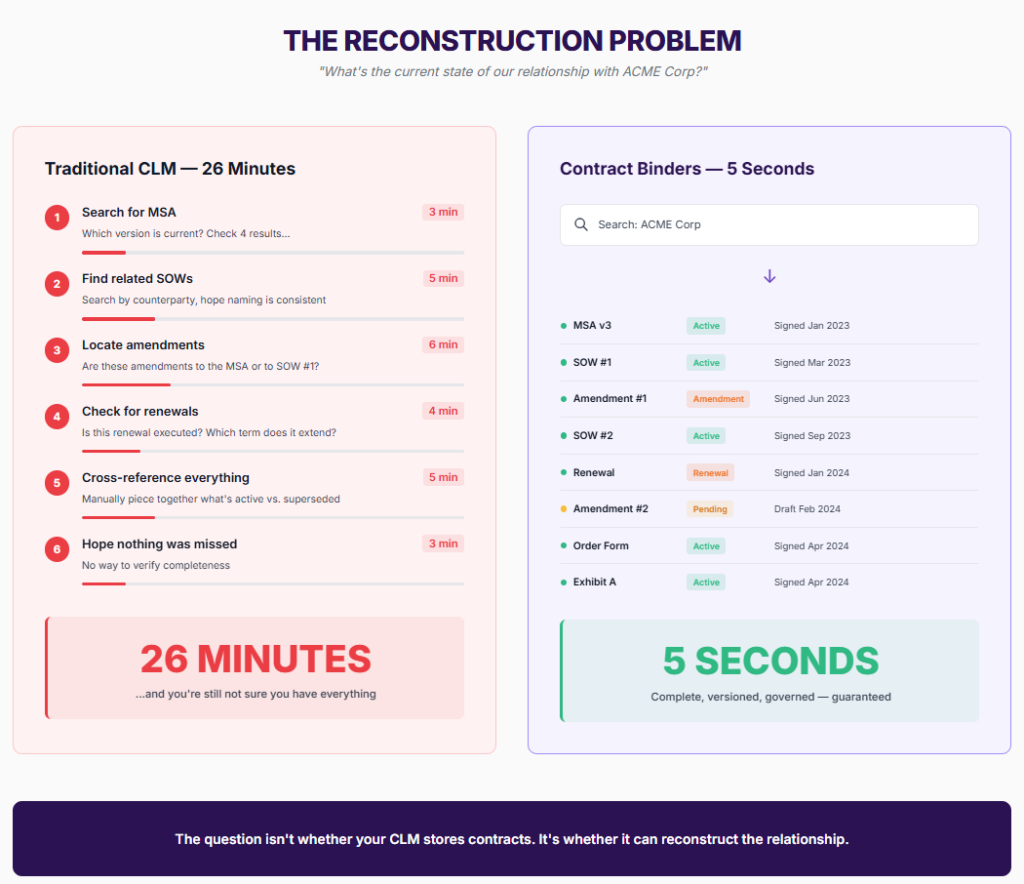
In contrast, traditional document-centric CLM systems treat each agreement as a separate record. Parent–child hierarchies connect related documents, but users must navigate and reconstruct context manually. As complexity increases, cognitive load increases.
The issue is not workflow automation—it’s architectural design.
Contract Binders as a Foundational Contract Management Architecture
Contract binders are not a bolt-on feature within a contract management system. Instead, they represent a foundational design choice in CLM architecture.
In a binder-based contract lifecycle management structure:
-
The relationship is the primary organizing principle
-
Documents are components of that relationship
-
Version control is coordinated inside the binder
-
The governing view remains clear as agreements evolve
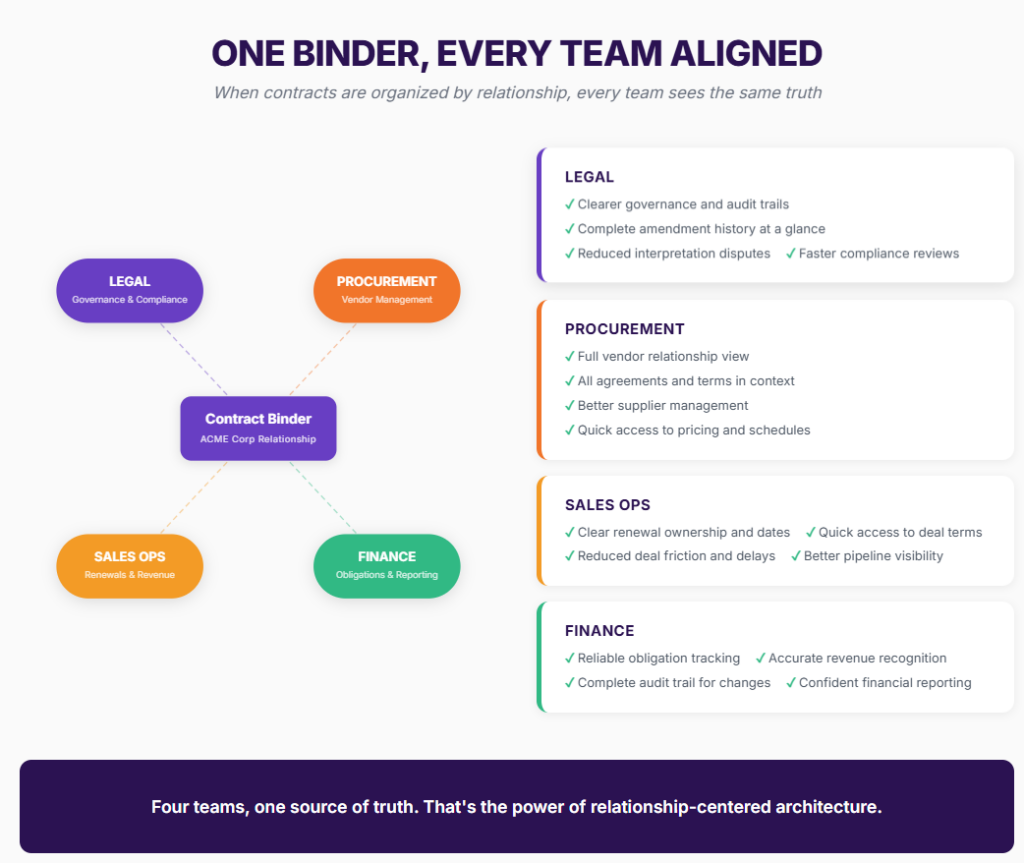
This structural approach aligns contract management systems with how contracts actually operate across legal, procurement, sales operations, and finance. As contract complexity grows, clarity remains durable.
Managing Complex Contract Relationships at Scale
A contract binder is designed to manage the full lifecycle of complex commercial relationships.
Organizations’ contract management systems often include:
-
Long-term customer relationships
-
Layered vendor agreements
-
Parallel SOWs across departments
-
Rolling renewals
-
Pricing modifications
-
Regulatory or regional addenda
Because the binder maintains a structured, versioned record of the entire relationship, organizations avoid forcing these agreements into rigid linear hierarchies.
Instead of asking, “Which document controls this relationship?” users can see the governing structure immediately.
Version Control Inside a Contract Binder
One of the most persistent challenges in contract management is determining which version of an agreement is currently in force. Contract binders address this through coordinated version control within the relationship record.
Structured views may include:
-
Latest View: The most up-to-date holistic representation of the relationship.
-
Active View: The version currently in force, even if amendments are pending.
-
Exact View: A preserved historical version for audit, compliance, or reporting purposes.
By embedding versioning within the contract binder structure, contract management systems eliminate manual interpretation and strengthen governance clarity.
Contract Binders vs. Document-Centric Contract Management Systems
A contract binder architecture:
-
Organizes contracts around the relationship itself
-
Maintains a clear governing record
-
Reduces manual interpretation
-
Preserves context as agreements evolve
-
Supports scalable governance
In contrast, many contract management systems:
-
Organize contracts as individual document records
-
Rely primarily on parent–child hierarchies
-
Require navigation and interpretation
-
Treat relationships as inferred context
This distinction is structural, not cosmetic. It determines whether a contract lifecycle management system merely stores agreements, or truly enables management and governance of complex contract relationships.
Why Architecture Matters in Contract Management
When organizations evaluate contract management platforms, attention often centers on:
-
Workflow automation
-
AI-driven contract review
-
Reporting dashboards
-
Clause libraries
These capabilities are important, but beneath every feature lies a more fundamental question: How are contracts structurally organized?
Architecture determines whether a contract management system:
-
Scales with organizational growth
-
Reduces risk
-
Improves visibility
-
Enables proactive governance
Contract binders represent a deliberate architectural decision—one designed to align contract management systems with how contracts actually function.
By organizing contracts around relationships rather than documents, contract binders provide the clarity, scalability, and governance required for modern contract management.
How Contract Logix Delivers Contract Binders
Contract Logix is purpose-built around a contract binder architecture. Rather than relying solely on document-centric hierarchies, Contract Logix organizes agreements around the commercial relationship they govern.
This relationship-centered design delivers:
-
Clear visibility into everything governing a customer or vendor
-
Coordinated version control within a single structured record
-
Reduced ambiguity around amendments and renewals
-
Scalable governance as contract portfolios grow
By embedding contract binders directly into its platform, Contract Logix provides a more durable architectural foundation for modern contract management.
To see how contract binders can improve visibility, governance, and scalability in your organization, request a demo or speak with the Contract Logix team about your contract organization strategy.