
Platform · Contract Intelligence Engine
Contract Intelligence Engine
AI contract data extraction that turns the terms locked in your contracts into structured, operational data, so the information that drives revenue, cost, and risk is usable without manual data entry.
From contract language to operational data
The terms that drive operational decisions, rates, rebate tiers, obligations, insurance requirements, payment milestones, are already inside your agreements. But assembling them means reading each contract and piecing the answer together, and across hundreds of contracts the question becomes too expensive to ask, so the decision gets made without the answer. Standard contract management captures a few top-level fields; the terms that decide revenue, cost, and risk sit one level down, in the schedules, exhibits, and rate tables.
The Contract Intelligence Engine is the bridge between unstructured contract language and structured operational data. It reads your source documents and writes structured data into the platform, both top-level metadata and line-item detail, and that data is available to dashboards, alerts, workflows, and integrations without manual data entry.
⚙
Customizable data extraction
Define your own contract terms, metadata, and extraction prompts. Update the fields as the business changes and reprocess the portfolio against the new parameters, so the data layer grows with the organization rather than being locked to a vendor-defined model.
☑
92 pre-built standard fields
Out of the box, the Engine extracts contract metadata against 92 pre-built standard fields, so the common terms every team needs are captured from day one with no configuration.
☷
Line-item granularity and Custom Data Objects
Beyond top-level fields, the Engine captures the line-item detail as Custom Data Objects: configurable, repeatable data tables with calculated fields and row-level dates that trigger their own alerts and workflows.
The Contract Intelligence Dashboard
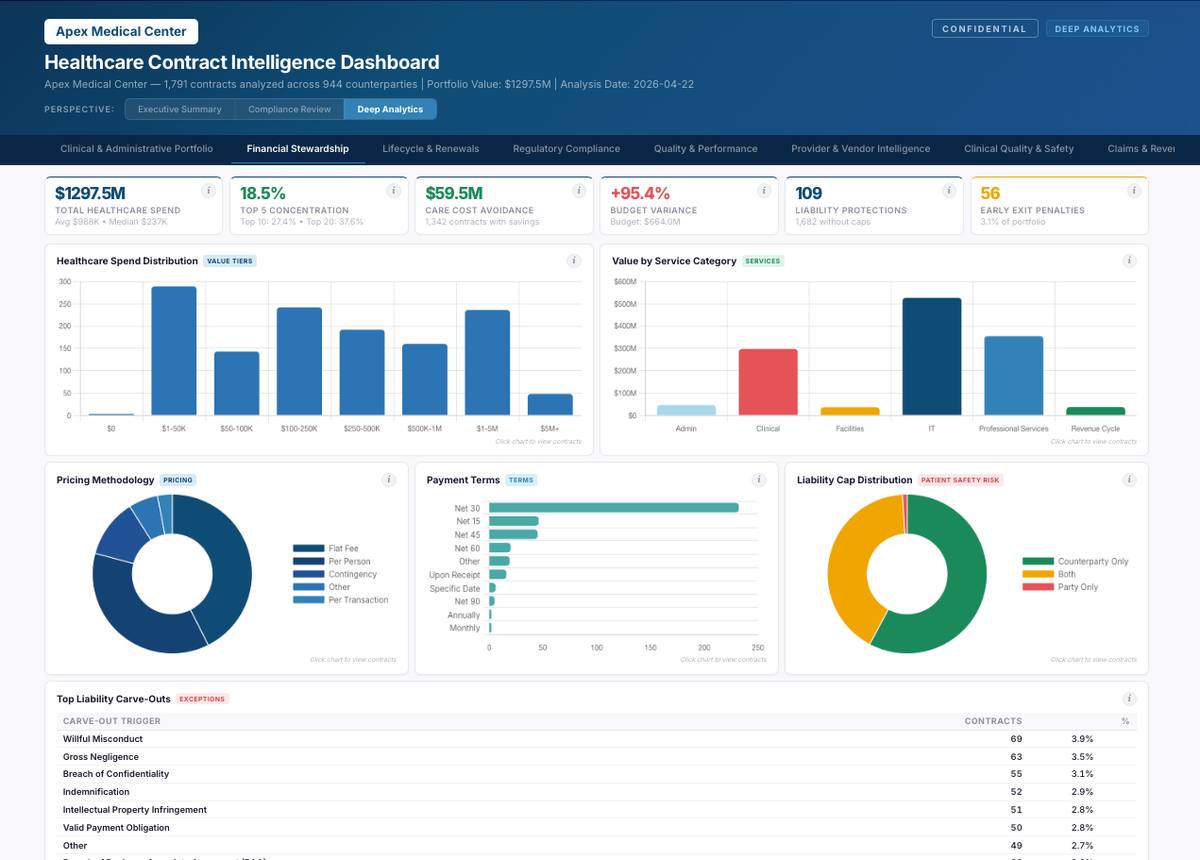
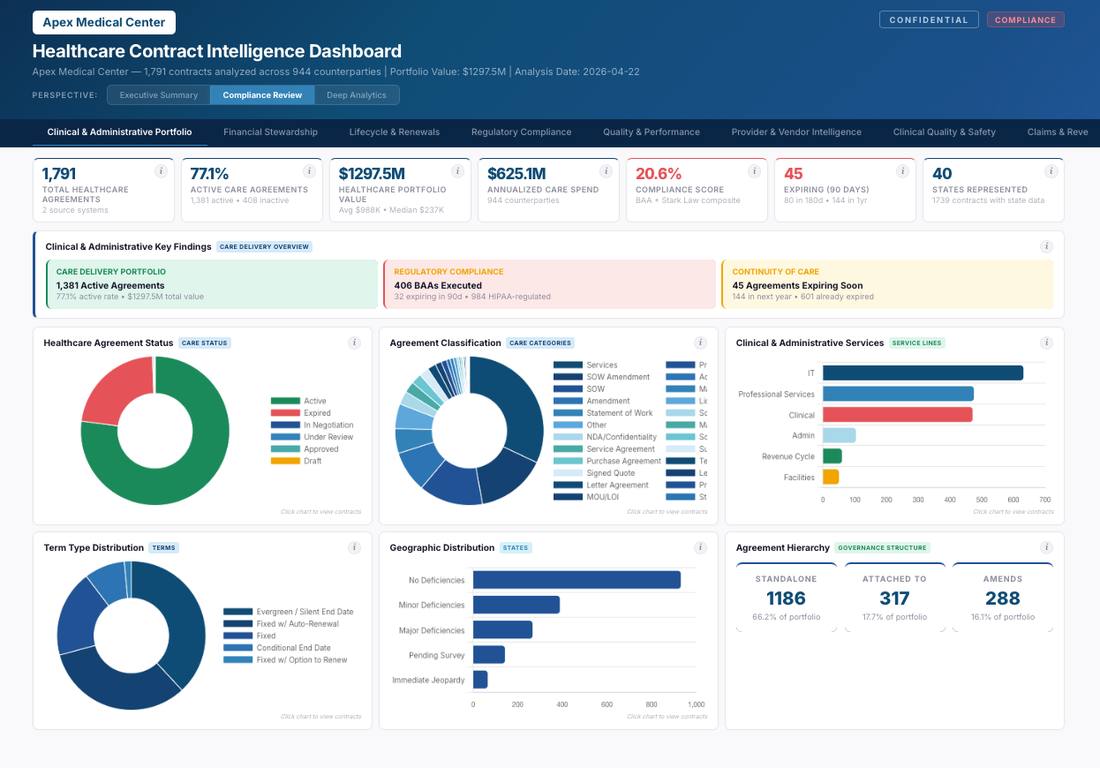
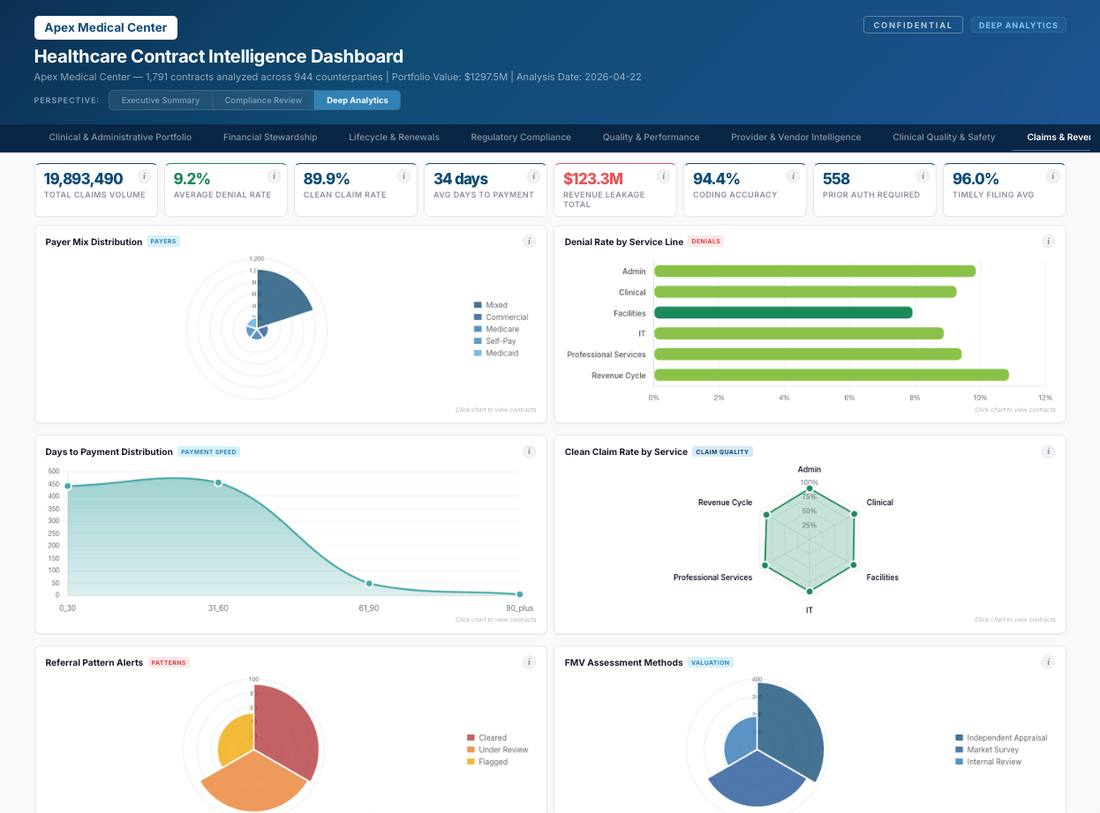
The Contract Intelligence Dashboard gives leadership a clear, current picture of the whole portfolio, on demand. It is fully configurable, so each organization can report on whatever contract insight it needs, from profitability and compliance to spend, risk, and renewals, drawn from its own contract data rather than a fixed set of vendor-defined reports. The 3-day question becomes a 5-minute answer.
AI contract analysis and data extraction
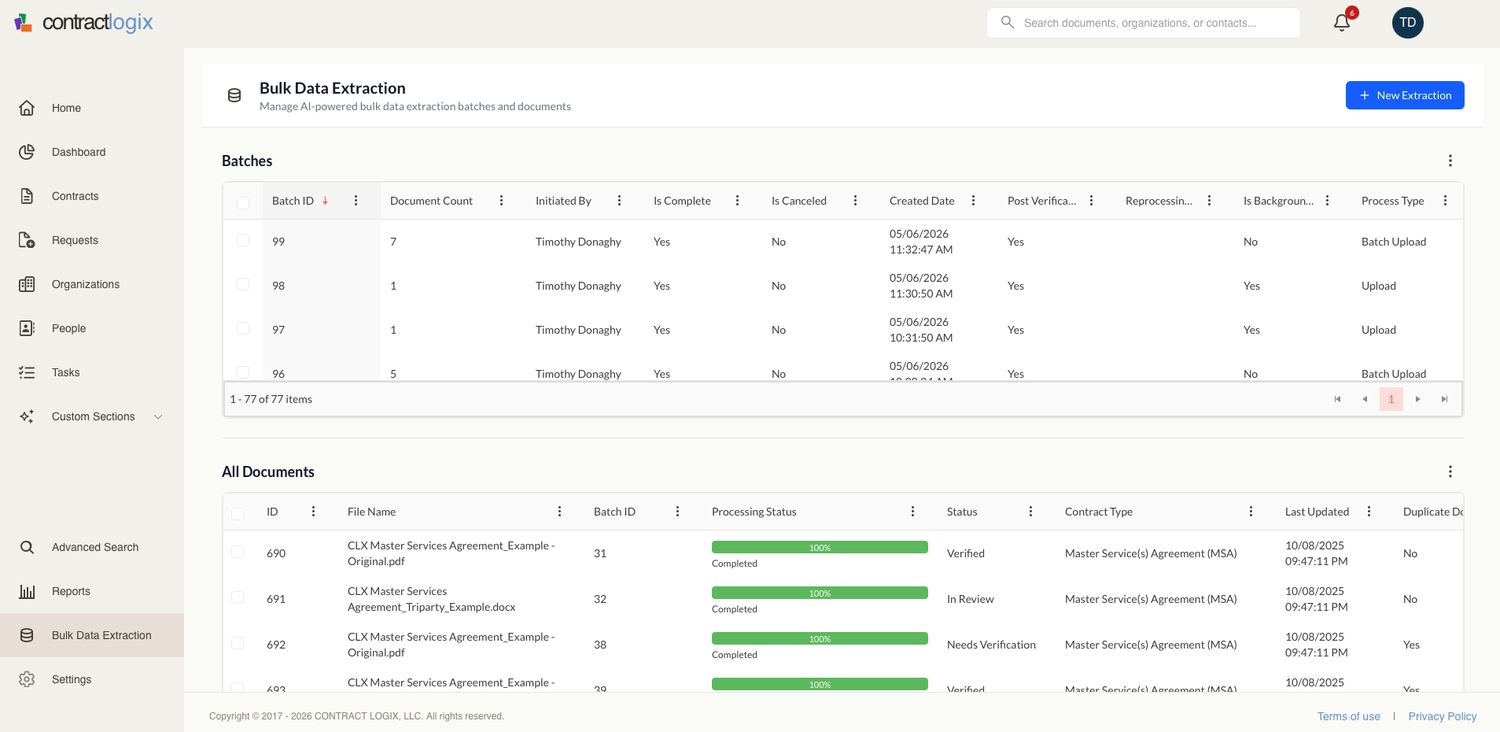
The Engine’s AI works in two ways. AI Contract Analysis reads your contract language and detects the key terms and clauses present. AI Data Extraction then pulls the contract properties you choose into Contract Logix as structured data.
AI Data Extraction (AIDE) delivers approximately 95%+ accuracy on the standard fields, rising to roughly 99% with human validation in the loop, and can populate any type of Custom Data Object, turning source documents into structured rows automatically.
Watch AI-Powered Contract Analysis in action · Read more on contract AI
Customizable metadata: handle any contract term
Beyond the 92 standard fields, your organization defines its own contract terms and metadata. You set the fields, the field types, the calculations, the validation rules, and the row-level date logic, all without code or a release cycle.
When a unique or industry-specific term matters, a custom rate basis, a bespoke obligation, a non-standard milestone, you define it once and it becomes first-class data the platform can track, alert on, and report. When the definitions change, you reprocess the existing portfolio against the new configuration, with no document re-loading.
What is a Custom Data Object?
A Custom Data Object is a configurable, repeatable data table held inside the contract record. Each row is a record; each column is a defined field with a chosen type, text, currency, date, percentage, calculated, picklist, lookup, multi-select, and more. Calculated fields derive values automatically and stay current. Required-field validation enforces completeness. Every row keeps a full audit trail.
The dates inside the object operate at the row level, so a single obligation, policy, or provider term date drives its own alert and workflow, independent of the contract’s own dates. Two object types support this: standard objects that roll templated rows across the portfolio with the right fields editable per record, and free-form objects for data unique to a single agreement. Objects attach to contract, request, organization, and contact records, so the same discipline applies wherever the data belongs.
Common Custom Data Object use cases
The same capability, structured rows and the calculations across them, answers the questions leadership cares about in a single query. A few examples.
1. Revenue integrity (rate tables)
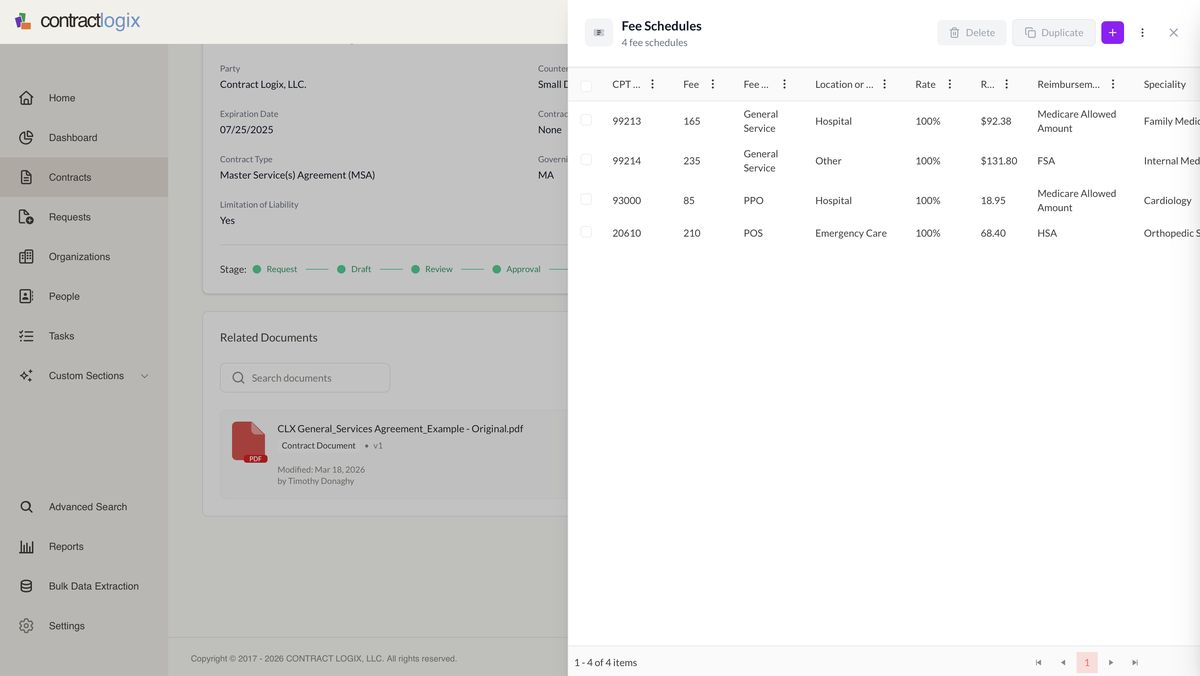
A rate-table object captures one row per code, with the rate, the reimbursement basis, and the agreed amount, and makes the set queryable. The renegotiation target list, every code priced below benchmark on a contract that renews within a year, comes from structured rows in seconds.
2. The Business Associate Agreement chain
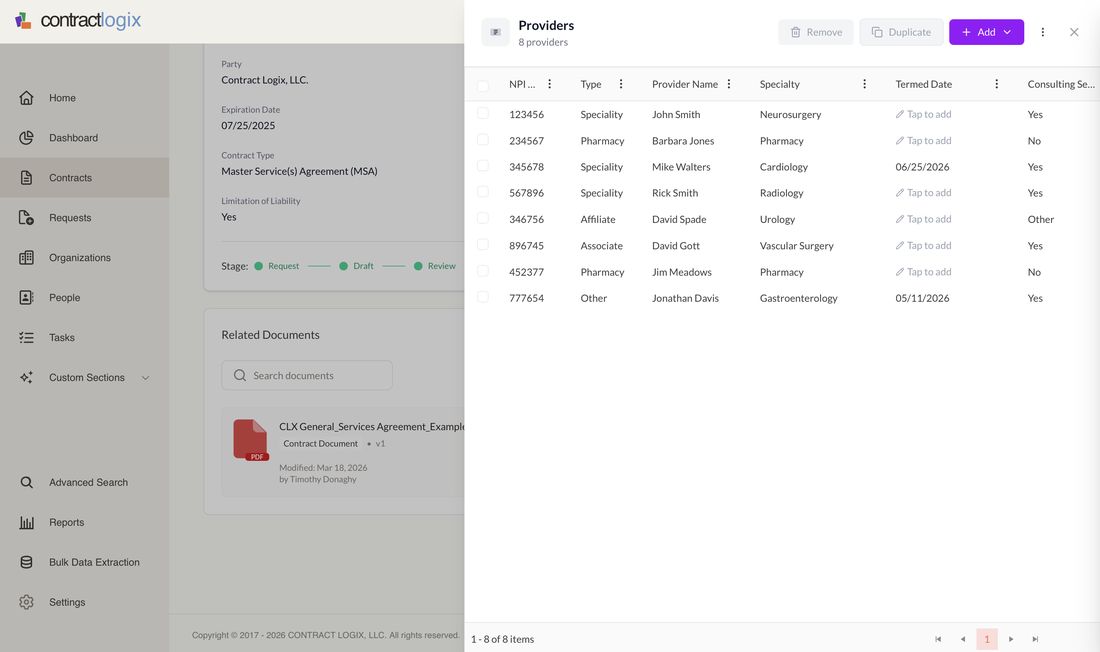
A multi-tier register, vendor, services, data categories touched, execution date, review date, owner, extended down the subprocessor chain. The question a regulator expects answered, every vendor handling protected health information right now without a current agreement, is a portfolio gap report.
3. Rebate capture
A rebate object holds one row per tier, a calculated accrued-amount column, and a row-level period-end date that triggers the alert: the business is a known amount of volume short of the next tier, and the window closes in 45 days. It converts an incentive that is easy to overlook into working capital the business collects.
4. Obligations and service-level credits
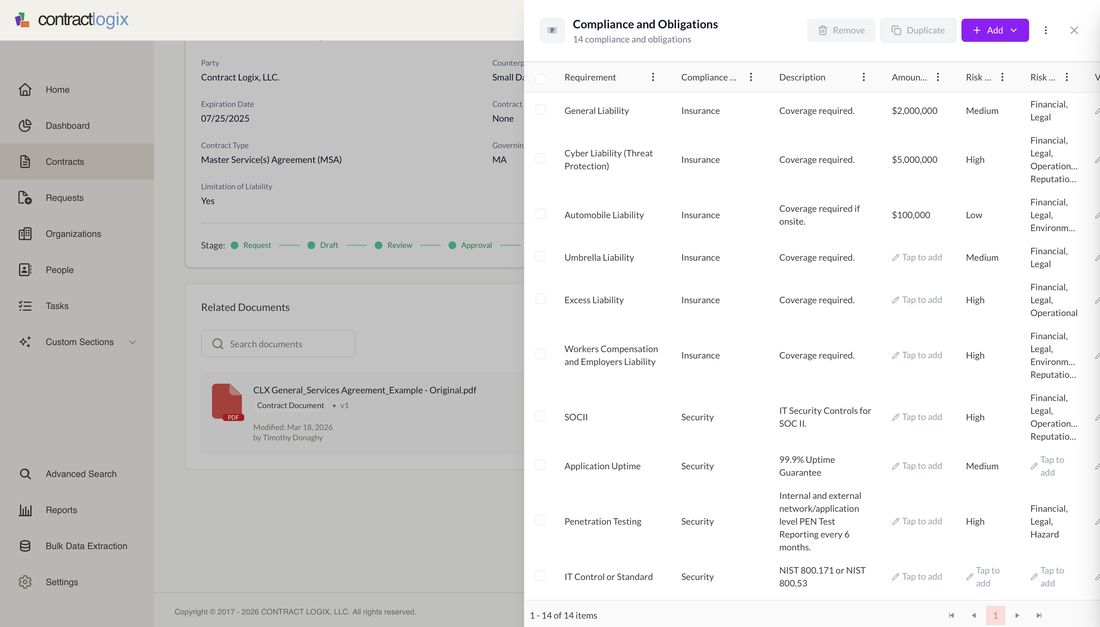
An obligation register records one row per commitment, risk-classified, with row-level verification dates that drive re-verification workflows, and it answers every high-risk obligation unverified in 90 days and total credit exposure across the vendor book.
5. Uninsured-vendor exposure
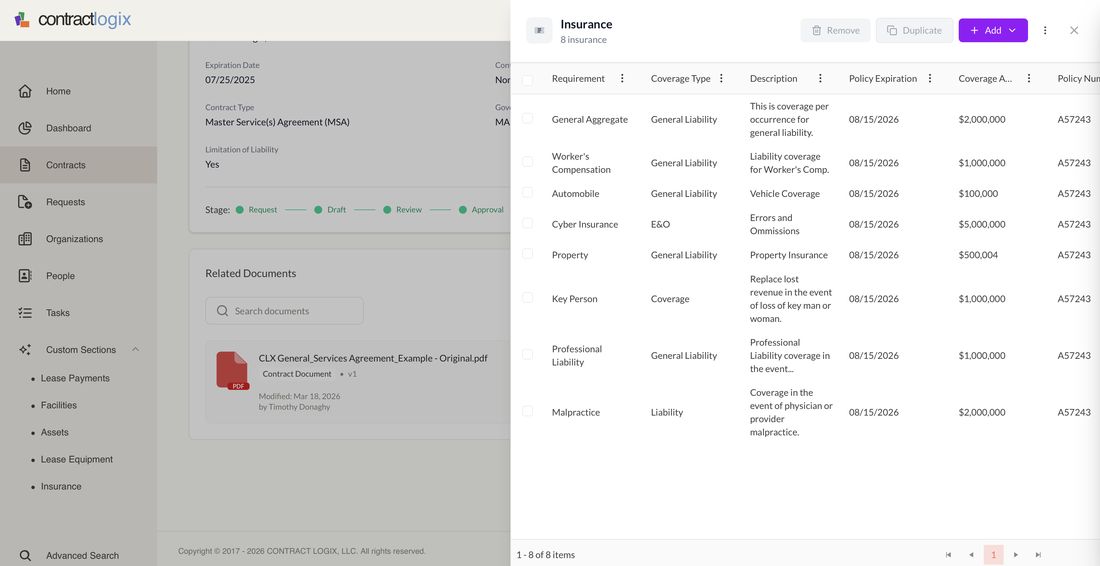
An insurance register keeps one row per required coverage per vendor, flagging any policy whose carried limit drops under the requirement, with a row-level expiration per policy. The question that protects the balance sheet, every active vendor with any required coverage lapsed or under-limit right now, is a multi-row, calculated, portfolio query.
6. Deadlines and workflows at the row level
Because dates can be set at the individual row level, a single obligation, insurance policy, or provider term date has its own deadline and automation, so the right alert reaches the right owner before the window closes, not one date for the whole contract.
For more, read our guide, Unlocking the Power of Your Contract Data.
How it works
1. Upload your contracts
Bring contracts in bulk or one at a time.
2. The Engine extracts the data
It extracts the 92 standard fields plus any custom fields and Custom Data Objects you define, and writes them into Contract Logix as structured rows.
3. Update and reprocess
When your data needs change, update the fields and reprocess the portfolio against the new configuration, with no document re-loading.
to 5 minutes
“I was asked by our CEO for some contract information that before Contract Logix would have easily taken me three days. I was now able to get the data out of Contract Logix in just five minutes.”
Frequently asked questions
- What is the Contract Intelligence Engine?
- It is the AI extraction layer inside Contract Logix that reads executed contracts and writes structured data, both top-level metadata and line-item detail, into the platform, so contract data is usable without manual data entry.
- What is the difference between standard fields and Custom Data Objects?
- Standard fields capture the top-level metadata every contract has, counterparty, effective date, renewal terms, governing law, and similar. Custom Data Objects capture the line-item detail one level down, the rate tables, payment milestones, obligations, and rebate tiers that live in schedules and exhibits, as repeatable rows.
- What are the 92 pre-built standard fields?
- They are the common contract metadata fields the Engine extracts out of the box, with no configuration, so the terms every team needs are captured from day one. You can add your own fields beyond them.
- What are Custom Data Objects?
- Configurable, repeatable data tables held inside the contract record. Each row is a record and each column is a typed field, and the object holds the line-item detail a single field cannot, with calculated fields and row-level dates and alerts.
- What field types do Custom Data Objects support?
- Text, numeric subtypes including currency and percentage, date, checkbox, lookup, multi-select lookup, picklist, multi-select picklist, and text block, plus calculated fields that derive a value from other fields in the row, such as Calculated Total = Quantity x Unit Price, with an optional manual override.
- Can the Engine extract line-item detail like rate tables, not just top-level fields?
- Yes. The Engine extracts the granular data objects inside the contract, rate tables, payment milestones, obligation chains, pricing schedules, and fee structures, so a single contract can carry hundreds or thousands of individual records, each with its own dates and attributes.
- How accurate is the extraction?
- AI Data Extraction (AIDE) delivers approximately 95%+ accuracy on the standard fields, rising to roughly 99% with human validation in the loop.
- What happens when our data needs change?
- You update the fields and extraction prompts and reprocess the existing portfolio against the new configuration, so the data layer grows with the organization without re-loading the documents.
- Can we extract data from contracts we have already executed, including legacy ones?
- Yes. You can process the existing portfolio, and for large legacy sets or complex requirements the Organize managed service designs the data model, configures the extraction, and bulk-imports the legacy base with quality control, so the existing book becomes operational data on a defined timeline.
- How is this different from a searchable contract repository?
- A repository stores the document and a few top-level fields, so the detail still has to be read out and assembled by hand, one contract at a time. The Engine writes the schedule, exhibit, and rate-table detail into structured rows you can query, sum, and track across the whole portfolio.
- Does the Engine work outside healthcare?
- Yes. The capability applies across industries and contract types, payer rate tables, supplier rebate stacks, vendor obligations, insurance registers, and more. Healthcare is where the line-item granularity proves out most clearly because its contracts carry the most complex structures.
- How does the Engine relate to the Contract Intelligence Dashboard and to Contract Logix Review?
- The Engine produces the structured data, and the Contract Intelligence Dashboard, alerts, workflows, and integrations all draw on it. Contract Logix Review is a separate capability that operates pre-signature during negotiation, while the Engine operates post-execution on the signed portfolio. They share a platform but are not stages in a sequence.
- What is the difference between AI Contract Analysis and AI Data Extraction?
- AI Contract Analysis reads contract language and detects the key terms and clauses present in an agreement. AI Data Extraction pulls the specific properties you choose into Contract Logix as structured data, both standard fields and Custom Data Objects. Analysis identifies what is in the contract; extraction turns it into usable data.
Make your contract data work for you
Get a guided walkthrough of how the Contract Intelligence Engine turns your contracts into structured data you can act on.