
Healthcare
Healthcare Contract Management Software
The healthcare contract intelligence platform built to manage contracts, maximize profitability, and streamline compliance. Contract Logix turns the complex compliance and financial data buried in your contracts into operational data your teams can act on.
The problem we solve
Healthcare contracts demand lifecycle management at volume, compliance discipline with audit-ready evidence, and ongoing tracking of the financial data that determines what the organization pays, owes, and recovers:
Compliance obligations
HIPAA, HITECH, Stark Law, Anti-Kickback, Joint Commission (JCAHO), DNV, Medicare billing, and BAA chains that must be tracked, evidenced, and defended on demand.
Financial commitments
Payer rate tables, physician compensation and FMV thresholds, rebates, and managed-care terms that determine what the organization pays, owes, and can recover.
Contract management complexity
Thousands of agreements across facilities, contract types, and counterparties, with parent-child relationships, amendments, and renewals to manage across the full lifecycle.
Contract review and drafting burden
First-pass reviews that consume attorney hours, with inconsistent positions across reviewers.
From contract pain to contract intelligence
Manage the contract lifecycle
Every stage from intake through renewal runs on a HIPAA-compliant repository with no-code automation, approvals, role-based security, and audit trails. Contract Binders keep parent and child agreements connected, so an amendment never separates from what it amends.
Maximize profitability
The Contract Intelligence Engine extracts the financial terms locked inside healthcare contracts, from payer rate tables at the CPT and DRG level to physician compensation against FMV thresholds, fees, escalators, and rebate stacks, and puts them to work as operational data finance and procurement can act on.
Streamline compliance
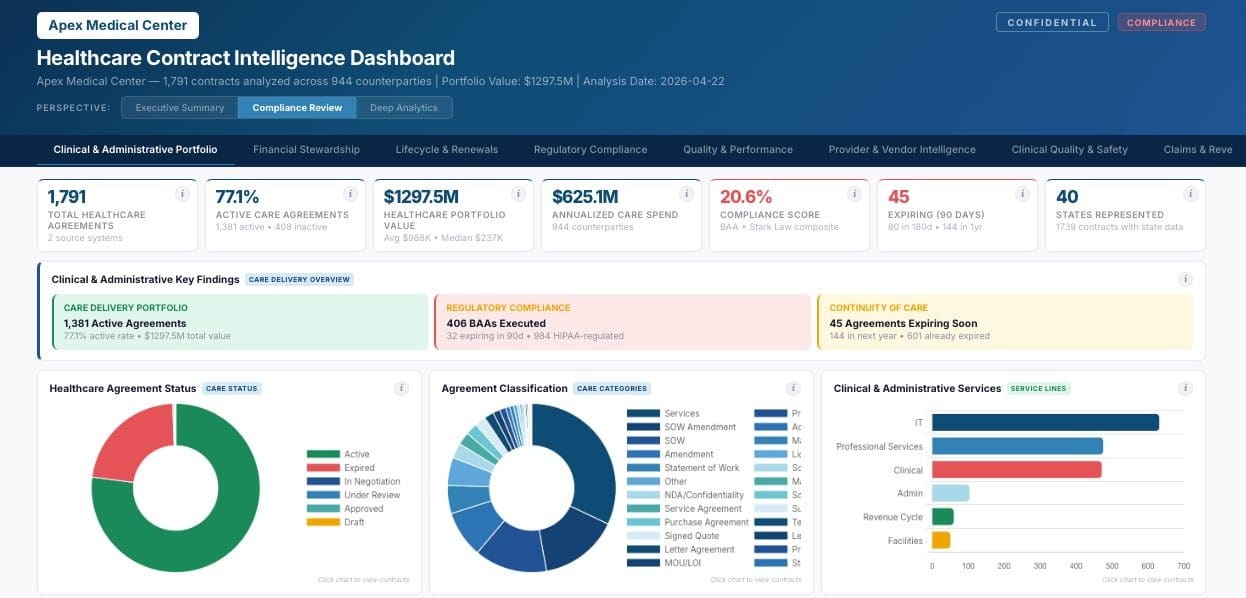
Required terms, approvals, and certifications are enforced in the workflow, so the system stays audit-ready. The Contract Intelligence Dashboard surfaces compliance in role-based views, from an executive compliance score to a daily expired-BAA violation report for OCR defense.
Review contracts in minutes
Contract Logix Review delivers first-pass redlines in minutes, inside Microsoft Word or Google Docs, applying your organization’s own standards. The optional Healthcare Package adds Horty Springer-authored templates that speed contract authoring and 15 review playbooks that keep positions consistent across every reviewer.
Built for every type of healthcare organization
Hospitals
Complete lifecycle management across the whole contract portfolio, with the cost and compliance terms governing service lines, suppliers, and physician arrangements made visible and audit ready.
Health systems
Enterprise contract management that holds up across every entity, facility, and affiliate, with governance, reporting, and access rights that follow the organizational hierarchy.
Health plans
Contract operations built for the payer side of the business, where network agreements, benefit terms, and reimbursement rates carry obligations that have to be administered, not just stored.
Managed care organizations
Lifecycle management for delegated and downstream arrangements, where the obligations an agreement creates demand the same tracking, evidence, and oversight as the agreement itself.
Physician practices
Enterprise-grade contract management scaled to a practice, so payer agreements, compensation terms, and vendor commitments get real oversight without a dedicated contracts function.
Rural and critical access hospitals
The full compliance and lifecycle discipline larger systems run, sized for a lean team, with the audit evidence regulators expect regardless of facility size.
Senior care and post-acute
Contract management across a distributed operating footprint, where vendor, payer, and staffing agreements have to stay current and survey-ready at every location.
Ambulatory surgery and specialty care
Lifecycle management for a high-volume, high-specificity portfolio, where payer rates, physician arrangements, and device and implant terms each carry financial consequence.
Home health and hospice
Contract management for a referral-driven business, where source relationships, payer terms, and regulatory obligations must hold together across a mobile workforce and frequent audits.
Optional Healthcare Package
Healthcare content authored with Horty Springer
Healthcare specific templates and review playbooks developed with law firm Horty Springer, a national leader in healthcare law.
With the optional Healthcare Package, Contract Logix includes Agreement Templates and Review Playbooks, ready to use on day 1.
Who it serves
Chief Financial Officer
Recovers payer underpayment and missed rebates, operationalizes physician FMV thresholds, and sees financial exposure across the portfolio.
General Counsel and Chief Compliance Officer
Produces audit-ready evidence for HIPAA, Stark, AKS, Joint Commission, and DNV on demand, with the daily BAA violation report at hand.
Chief Administrative Officer
Answers for contract administration, compliance, and operations, with the obligation tracking and reporting that makes each of them defensible.
VP of Legal Operations
Standardizes first-pass review, tracks obligations, and clears renewals across many entities.
VP of Provider Network
Keeps provider and payer terms and rate structures as structured data, so rate changes and network obligations stay visible across every agreement.
Director of Government Pricing
Tracks rebate stacks, managed-care terms, and IRA Maximum Fair Price obligations against the contract record.
What sets Contract Logix apart
- A CLM designed for healthcare compliance: the data model handles healthcare’s complex contract structures, with a 6-year audit trail and role-based access supporting OCR, Joint Commission, and DNV survey readiness.
- Configurable AI extraction that captures contract terms at line-item granularity, with fields you define and reprocess as needs change.
- AI contract review built into the CLM, so first-pass redlines happen where the contract already lives, with no export and no second vendor.
- Horty Springer-authored healthcare templates and review playbooks through the optional Healthcare Package.
- Enterprise-grade security on Microsoft Azure: SOC 2 Type II, HIPAA, and FISMA, with a 6-year audit trail.
- Rapid deployment, with a 90-day go-live target for most healthcare implementations.
Built for every healthcare agreement type
- Payer contracts. Rate tables at the CPT and DRG level, fee schedules, escalators, and managed-care terms, so finance can hold remittance to the contracted rate.
- Physician arrangements. Services, employment, and participation agreements with compensation tracked against FMV thresholds and referral documentation, so Stark and Anti-Kickback exposure stays visible.
- Business Associate Agreements. A live BAA registry tied to the vendor relationships it covers, with status and expiration visible daily.
- Supplier and GPO agreements. Vendor and group-purchasing terms, rebate stacks, and renewal dates, surfaced so missed rebates and unfavorable auto-renewals do not slip through.
Proven at scale
More than 60,000 users across hundreds of organizations run their contract operations on Contract Logix.






Bayshore Healthcare reduced pre-execution by 75%
Bayshore needed to centralize and modernize its contracting processes so it could focus on its core mission.
Enterprise-grade security on Microsoft Azure
Microsoft Azure hosting, SOC 2 Type II, HIPAA, and FISMA compliance, and a 6-year audit trail. See Security & trust for the full specification.
Healthcare contract management: a complete guide
The cost of healthcare keeps rising, increasing pressure on hospitals, physicians, and other providers to reduce costs and improve efficiency. One area where healthcare organizations can achieve significant savings is better healthcare CLM software. This guide explains why healthcare contract management matters and the best practices for running a successful program.
What is healthcare contract management?
Contract lifecycle management (CLM) is a comprehensive approach to managing the entire lifecycle of a contract, from initial negotiation through its eventual expiration or renewal. It includes the processes for negotiating, approving, executing, monitoring, and terminating agreements.
Healthcare contract management applies that discipline to the contracts between providers and their vendors, suppliers, payers, and other third-party organizations. It covers not only negotiating terms before signing, but also monitoring and enforcing contractual obligations throughout the life of the agreement.
It requires close attention to detail and a working knowledge of healthcare regulations and applicable laws, such as HIPAA. Healthcare contract managers also make sure every contract is legally binding and enforceable, and they stay current with the changing laws and regulations that affect the industry.
Why healthcare contract management is critical
Healthcare contract management helps ensure compliance with regulatory requirements, reduces costs, and improves efficiency. The right system makes it easy to track contractual obligations and find the places where the organization can save money.
It also supports better patient outcomes by giving providers a consistent framework for services, fees, and agreements, and it helps organizations address potential issues before they arise. When a provider has an agreement with a supplier for medical supplies at a set rate, for example, contract management makes it easy to track changes to the terms and confirm the supplier is meeting its obligations.
Finally, contract management supports the development of new healthcare services and products, helping teams find gaps, negotiate favorable rates, and deliver new offerings with confidence.
A brief history
Tracking healthcare contracts was once a largely manual process built on physical documents. As technology advanced, organizations adopted electronic filing systems and standardized templates to improve accuracy and consistency. In the mid-1990s, software designed for healthcare contract management began to appear, and as regulations such as HIPAA and the Stark Law took effect, the discipline grew far more sophisticated. Today it involves many stakeholders, from administrators to IT, and organizations manage their contracts more effectively than ever.
Healthcare CLM best practices
Several best practices make a healthcare CLM program successful:
- Create clear policies and procedures for negotiating and executing contracts, and use standard templates to keep terms consistent.
- Establish a process for tracking deadlines, renewals, and contractual obligations.
- Automate the contract management process with software, from intake and approval workflow to alerts.
- Structure and enforce contract-related compliance requirements in the workflow, so required terms, approvals, and certifications are met and the organization stays audit-ready for HIPAA, Stark Law, Joint Commission, and DNV.
- Extract the line-item data inside contracts, from payer rate tables at the CPT and DRG level to physician compensation against FMV thresholds, escalators, and rebate stacks, so finance can recover revenue and control costs.
- Regularly review contracts for accuracy, compliance, and new opportunities.
- Maintain accurate, searchable records of every contract so changes and discrepancies surface quickly.
What to look for in healthcare CLM software
Automating contract management with software is itself a best practice. Look for a healthcare CLM system that:
- Facilitates electronic signature capture and template-driven contract creation.
- Stores documents securely with role-based access, plus fast full-text and metadata search.
- Generates automated alerts when deadlines, renewals, or obligations come due.
- Automates no-code workflow for contract approval and routing.
- Structures and enforces the required terms, approvals, and certifications in the workflow, with a complete audit trail, so you stay audit-ready for HIPAA, Stark Law, Joint Commission, and DNV.
- Captures the line-item data inside contracts, from payer rate tables at the CPT and DRG level to FMV thresholds, escalators, and rebate stacks, so finance can recover revenue and control costs.
- Provides AI-assisted contract review and redlining against your organization’s own standards.
- Integrates with the enterprise systems you already run, from ERP and CRM to e-signature.
- Meets healthcare security and compliance requirements, including HIPAA and SOC 2 Type II, hosted on Microsoft Azure.
How Contract Logix helps
Contract Logix is a leader in healthcare contract management, with a suite of tools to manage contracts across the full lifecycle. Contract Logix offers:
- No-code automated workflows for faster contract approvals.
- AI-powered data extraction that turns contract terms into structured, reportable data.
- Contract Logix Review for AI contract review and redlining inside Microsoft Word and Google Docs.
- A secure, searchable digital contract repository.
- Electronic signature capture.
- Role-based security and audit trails for HIPAA and regulatory compliance, hosted on Microsoft Azure.
- Integrations with the enterprise systems you already run.
With Contract Logix, healthcare organizations streamline their contract processes and get more value from every agreement.
Featured resources
CLM for Healthcare guide
The core components of contract lifecycle management for healthcare.
Contract risk assessment
Where to begin with contract risk assessment for healthcare organizations.
Compliance management
Handling contract compliance management in healthcare.
5 benefits of healthcare CLM
Healthcare contract lifecycle management: 5 benefits of CLM software.
Healthcare CLM articles and guides
The OIG seven fundamental elements
What an effective compliance program requires, and where contract data supplies the evidence.
Sunshine Act and Open Payments
Reporting obligations on payments to physicians, and the agreement terms that drive them.
Medicare Advantage prior authorization
The rules reshaping prior authorization, and the delegated agreements that carry them.
Healthcare CLM FAQ
- What makes contract management healthcare-specific?
- Healthcare contracts hold complex, line-item data that a standard CLM does not model: payer rates at the CPT and DRG level, physician compensation against FMV thresholds, BAA chains, and rebate stacks. Healthcare-specific contract management captures those terms as structured data, with HIPAA-compliant audit defense.
- Is Contract Logix HIPAA-compliant?
- Yes. Contract Logix runs on Microsoft Azure and is SOC 2 Type II, HIPAA, and FISMA compliant, with role-based access, a 6-year audit trail, and BAA management built in.
- How long does implementation take?
- Contract Logix targets 90 days to go-live for most healthcare implementations, measured in weeks rather than the multi-year programs enterprise platforms require. Scope, data volume, and integrations affect the schedule.
- How does it help with Stark and BAAs?
- Contract Logix captures physician compensation against FMV thresholds and maintains a live registry of every Business Associate Agreement. Dashboards surface Stark and Anti-Kickback exposure and flag active relationships with expired BAAs, producing audit-ready evidence on demand. This is general information, not legal advice.
- How does it support accreditation and survey readiness?
- Contract Logix keeps the contract evidence a surveyor asks for current and retrievable: executed agreements, Business Associate Agreements, contracted-services terms, and the credentialing obligations attached to them, each with a complete audit trail. Compliance teams produce the documentation on request instead of assembling it under deadline. See accreditation readiness.
- How does it help recover payer underpayments?
- The Contract Intelligence Engine extracts payer rate tables at the CPT and DRG level, so contracted rates become operational data. Finance can compare contracted rates against remittance, surface underpayment and missed escalators, and act before the variance hits the P&L.
- What healthcare agreement types does it handle?
- Contract Logix supports all contract types in healthcare, including payer contracts, physician services and employment agreements, Business Associate Agreements, managed-care and supplier and GPO agreements, and more, with the line-item structures inside each. The optional Healthcare Package adds Horty Springer-authored templates and review playbooks.
- How can I estimate my compliance exposure?
- The Healthcare Contract Compliance Exposure Estimator sizes the risk sitting in a contract portfolio by obligation type and agreement volume, so compliance and finance start from a shared number rather than an argument. It takes a few minutes and requires no contract data.
Maximize profitability, streamline compliance, and manage your contracts at the speed of business.
[/vc_column_text][/vc_column][/vc_row]

Connect With Us:


Call Us
1-866-371-4445
Address
Contract Logix, LLC
55 Technology Drive
Suite #103
Lowell, MA 01851
All trademarks and registered trademarks are the property of their respective owners
Copyright 2026 Contract Logix, LLC All Rights Reserved